City Park, Fountain and the Forum Stadtpark - Between History, Nature and Modern Art
Today, the park seems like an obvious part of the city.
In fact, however, something completely different used to be here:
a free area outside the old city walls - the so-called Glacis.
Where people stroll today, soldiers, defensive structures, and drill grounds once stood.
It was not until the 19th century that the idea emerged to transform the area into a large public park.
This was primarily due to the Graz mayor Moritz Ritter von Franck.
Starting in 1868, he advocated strongly for Graz to finally have a large public park.
At that time, this was by no means a given.
Many wanted to build on the land or use it economically.
Nevertheless, Franck prevailed -
and that is exactly why the City Park exists today.
If you look around, you will even discover a monument and a so-called Franck Oak in his honor.
The park was ultimately designed based on the model of English landscape gardens:
meandering paths, large grassy areas, old avenues, and areas designed to appear as natural as possible.
And although you are in the middle of Graz, you surprisingly forget that here quite quickly.
The City Park is also botanically quite fascinating.
Here stand around 2,000 trees and over 150 different species of trees — including exotic species that were planted at the park's opening.
Particularly famous is the giant Caucasian Wingnut, one of the most impressive old trees in the city.
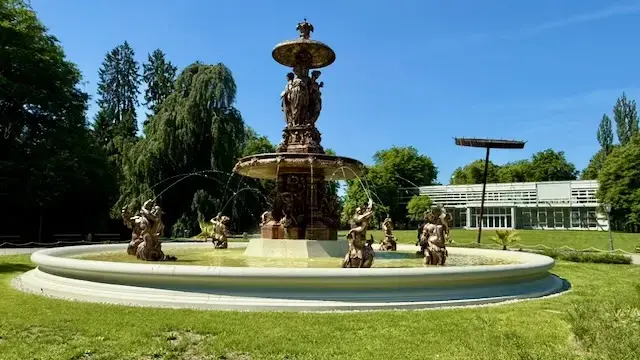
Around the City Park Fountain, you can still sense the slightly elegant character of the Gründerzeit.
The fountain itself dates back to the 19th century and was originally created for the Vienna World's Fair.
Additionally, you will find monuments, busts, and sculptures throughout the park.
Peter Rosegger, Robert Stolz, Johannes Kepler, or Moritz von Franck -
the City Park has almost become a small open-air gallery of history for Graz over time.
And then suddenly, there is something completely different here:
a giant nail.
The so-called City Park Nail by the artist Hartmut Skerbisch is one of the most well-known modern artworks in the city.
To this day, Graz residents debate whether it is genius, strange, or simply typical art.
Not far from here is also the Forum Stadtpark.
From the outside, the building appears rather inconspicuous.
Culturally, however, it has been one of the most important places for modern art, literature, and music in Austria for decades.
Careers of artists and authors such as Peter Handke, Barbara Frischmuth, or Alfred Kolleritsch began here.
The Forum has always been consciously a bit more experimental than classical cultural institutions.
Less opera ball.
More creative ideas.
And that is exactly what makes the City Park exciting:
Between old trees, historical monuments, and quiet paths, modern art, alternative culture, and a giant nail suddenly appear.
Graz manages such combinations surprisingly often.